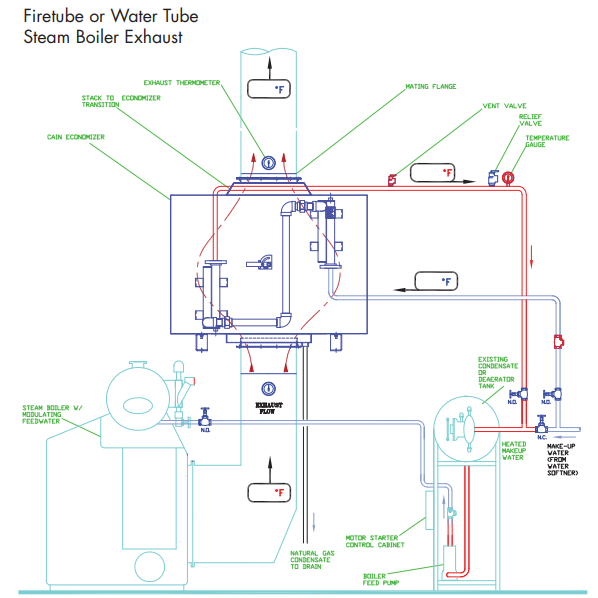
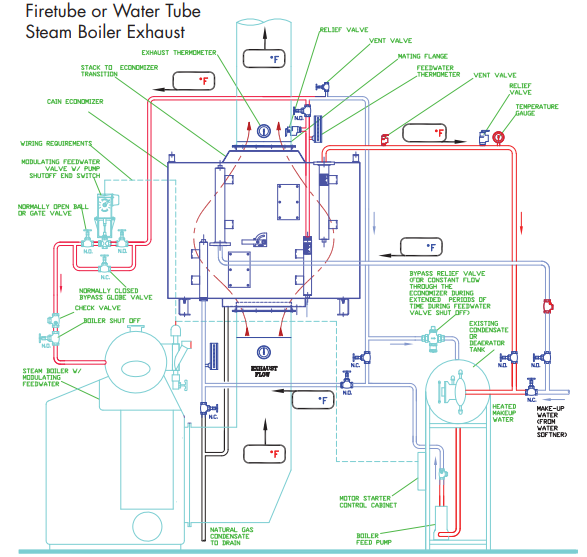
PULSE measures exactly what your boilers burn. Heat Recovery recovers it in two versions — CXL single-stage and DXL two-stage condensing recovery — heat from above and below the water dew point locked in the water vapour — and every kilogram is counted on your own meters. Only measured savings count.
Four figures, one source. Fuel is metered at the burner, recovered heat at the feedwater, water on the condensate line — and the cost per tonne of steam is compared with the plant's own 12-month baseline, not with a brochure.
Most economizer pages publish one efficiency figure, taken at one datasheet condition. This page publishes the window, the two measurement legs and the calculation, so a third party can take the same inputs and get the same number.
| Published as | What you get | Window and uncertainty | Third party can re-derive it |
|---|---|---|---|
| Vendor brochure | One headline percentage, usually measured at a single load point on a datasheet | No operating window, no uncertainty, no baseline | No. The calculation is not published |
| Typical ESCO guarantee | A guaranteed percentage or a dollar figure, settled against a contract baseline | A contract window, usually reconciled once a year | Partly. It depends on the baseline clause you signed |
| Heattech PULSE, this page | 8.47 % of fuel on one demo plant, IPMVP Option B, boundary boiler plus economizer | 12-month baseline, 1-minute samples, two independent legs | Yes. Baseline, boundary and calculation are published before you sign |
The first two rows describe how savings are commonly published in this industry. They are not measurements of any named supplier. The third row is the demo plant on this page, over the same window in which cost per tonne of steam moved from $69 to $63.
One product line, two configurations: CXL with one stage and DXL with two. Both cool the flue gas to 77–49 °C (170–120 °F), below the water dew point, and both land on the same measured saving — the difference is only where the recovered heat is sent.
Both are condensing exchangers built for the same physical job: taking the flue gas from 149–427 °C down to 77–49 °C, below the water dew point of the gas. That exit temperature is the target, not a coincidence. What differs is where the recovered heat is sent, and how many hours a year the exchanger stays in the condensing range.
CXL is measured once. The boundary is the boiler plus the economizer: flue-gas enthalpy in and out, and heat absorbed by the makeup or process water, corrected to steam output. One number comes out — 8.47 % of fuel on our demo plant (Avis Foods), IPMVP Option B. No split is reported for CXL.
DXL adds a second stage, so it carries an extra flue-gas temperature pair — gas in and gas out of the condensing stage — which measures the additional heat taken from the flue gas. That pair is what splits the same 8.47 % into 5.92 % recovered above the water dew point and 2.55 % from latent heat. Both numbers are measured on the same demo plant, not a catalogue figure.
No equipment is quoted before the baseline exists. The clocks below are the ones this page already runs on: a 12-month baseline, four metered streams at one-minute samples, a daily report.
We send one page: fuel type, boiler size, flue temperature and the meter you already read. The survey is scheduled when the answers arrive, and the baseline is measured before any hardware is quoted.
CHR sits on the flue gas and heats water before the deaerator; where the gas is cooled below the water dew point the vapour condenses, and the condensate is drained handling. A flue bypass and a safe-shutdown procedure are part of the installation requirements; the burner is not modified.
Fuel, steam, flue gas and condensate are sampled every minute. You get a daily report and, on the Plant plan, a monthly PDF. If the feedwater leg and the flue-gas leg disagree, no saving is booked.
Heat recovery is the visible half. Before it comes metering, and beside it comes combustion — two modules that decide whether the saving on the dashboard is real and repeatable.
Fuel, steam, flue gas and condensate — sampled every minute and rolled up by PULSE. This is the package the M&V protocol is built on.
O₂ trim, excess-air control and a three-point tune on the burner train, so the flue leaving the boiler is already as small as it should be.
The demo plant recovers 771 kW right now. Move the hours and the same rate is applied across a year. This is arithmetic on a published figure, not a forecast for your boiler.
Estimate only. Formula: recovered heat (kW, read from the demo plant's live figure) × hours per day × 365 ÷ 1,000 = MWh per year. It assumes the plant runs at that rate all year. It is thermal energy at the feedwater, not metered fuel, and it excludes standby, part-load and seasonal effects.
The subscription covers PULSE — meters, dashboards, reports, M&V evidence. Two months free on annual billing. Hardware and installation (MV, CT, CXL, DXL) are quoted per site, against the savings we measure there.
Priced per boiler actually running — an idle boiler is not billed. Equipment (MV, CT, CXL, DXL) and installation are quoted per site from the measured saving, so the payback is documented before you sign.
Open the documents our engineers hand over before a survey — the same numbers this page is built on.
A measured saving is only useful if the boundary around it is explicit. These are the things this page does not promise.
Each answer is tied to a number or a document already on this page.
They are the same condensing line in two configurations. CXL recovers in a single stage: flue gas is cooled below the water dew point and the heat goes into makeup or process water. DXL splits recovery into two stages, stage 1 preheating boiler feedwater and stage 2 preheating makeup water. CHR is the name of the condensing technology both models use, not a model name, and neither model is a dry economizer. On the demo plant the measured result is 8.47 % of fuel, IPMVP Option B, boundary boiler plus economizer.
For LPG flue gas the water dew point is about 54.6 °C. Below it the vapour condenses and the latent heat becomes recoverable, which is the whole point of CHR. The real constraint is the acid dew point, which sits higher for fuels carrying sulphur, so CHR uses corrosion-managed materials, a drain path and a bypass that takes the unit out of the gas path.
Four streams are sampled every minute: fuel at the burner, steam, flue-gas temperature and condensate. Recovered heat is measured at the feedwater and flue-gas temperature is the cross-check, then cost per tonne of steam is compared with your own 12-month baseline. If the two legs disagree, we do not book the saving.
The M&V protocol publishes the baseline, the boundary, the calculation and the dispute path before you sign. We do not print a tolerance we have not measured, and the two-leg rule turns a disagreement into no booked saving rather than a wider error bar.
The tie-in is planned around a shutdown, and a flue bypass plus a safe-shutdown procedure are part of the installation requirements. CHR does not touch the burner or its certification; CHR adds a condensing stage with its own drain handling.
PULSE is $149/month for up to 3 boilers, $299/month for up to 6, and $39 per boiler per month above that with a $499 monthly minimum; the first 14 days are free. Equipment and installation are quoted per site from the measured saving, which is what documents the payback before you sign.
Your operators keep running the boilers. PULSE samples, rolls up and reports: a live dashboard, a daily report, and a monthly PDF savings report on the Plant plan. The live demo is read-only, so you can watch the numbers move before any conversation.
Yes. The live plant is public and read-only, the M&V protocol and the datasheet are open documents, and the sizing tool runs the gas-side and water-side balance yourself. None of it needs a call.
The next step is one page of site questions: fuel, boiler size, flue temperature and the meter you already read. If the numbers do not support a saving, we say so before anyone quotes hardware.