CHR — condensing heat recovery (CXL / DXL)
One product line, two configurations: CXL with one stage and DXL with two. Both cool the flue gas to 77–49 °C (170–120 °F), below the water dew point, and both land on the same measured saving — the difference is only where the recovered heat is sent.
The two configurations
CXL — single stage

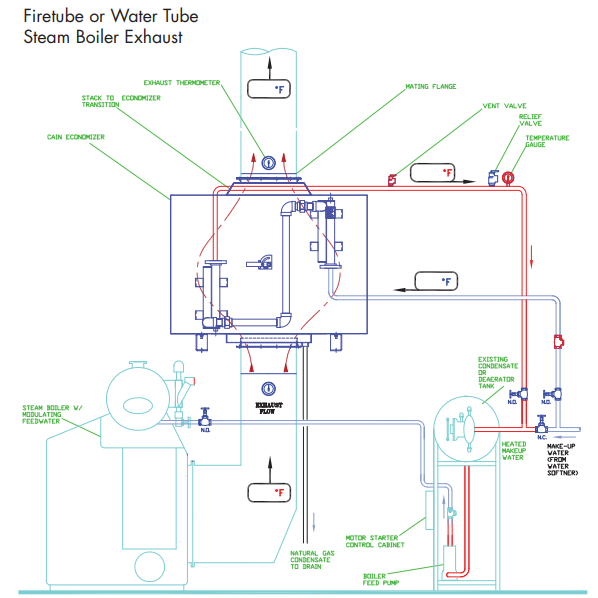
- One condensing stage: all recovered heat goes into one stream.
- Heat sink: makeup water or process water.
- Fewest connections, simplest piping, lowest installed cost.
- Choose it when a steady flow of cold makeup or process water is available.
DXL — two stage

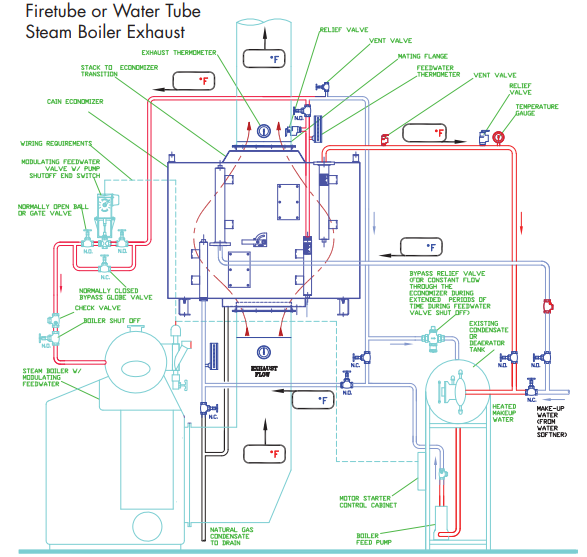
- Two condensing stages in series: stage 1 preheats boiler feedwater, stage 2 preheats makeup water.
- Heat sink: feedwater first, makeup water second.
- Choose it when makeup water is limited or intermittent — feedwater flow keeps the unit condensing.
- Highest total annual recovery of the two, because condensing hours do not depend on makeup demand.
Why both cool to the same temperature
Both are condensing exchangers built for the same physical job: taking the flue gas from 149–427 °C down to 77–49 °C, below the water dew point of the gas. That exit temperature is the target, not a coincidence. What differs is where the recovered heat is sent, and how many hours a year the exchanger stays in the condensing range.
How the saving is measured
CXL is measured once. The boundary is the boiler plus the economizer: flue-gas enthalpy in and out, and heat absorbed by the makeup or process water, corrected to steam output. One number comes out — 8.47 % of fuel on our demo plant (Avis Foods), IPMVP Option B. No split is reported for CXL.
DXL adds a second stage, so it carries an extra flue-gas temperature pair — gas in and gas out of the condensing stage — which measures the additional heat taken from the flue gas. That pair is what splits the same 8.47 % into 5.92 % recovered above the water dew point and 2.55 % from latent heat. Both numbers are measured on the same demo plant, not a catalogue figure.
Model selection by duty
Codes are ours, in 100 kW steps; the code follows the required duty at the flue-gas conditions above.
| Code CXL | Code DXL | Duty (kW) | Boiler (t/h steam) | LPG (kg/h) | Flue gas (kg/h) | Sensible (kW) | Latent (kW) |
|---|---|---|---|---|---|---|---|
| VX-CXL-0100 | VX-DXL-0100 | 100 | 1.3 | 72 | 1.326 | 52 | 48 |
| VX-CXL-0200 | VX-DXL-0200 | 200 | 2.5 | 143 | 2.652 | 104 | 96 |
| VX-CXL-0300 | VX-DXL-0300 | 300 | 3.8 | 215 | 3.977 | 157 | 143 |
| VX-CXL-0400 | VX-DXL-0400 | 400 | 5.1 | 287 | 5.303 | 209 | 191 |
| VX-CXL-0500 | VX-DXL-0500 | 500 | 6.3 | 358 | 6.629 | 261 | 239 |
| VX-CXL-0600 | VX-DXL-0600 | 600 | 7.6 | 430 | 7.955 | 313 | 287 |
| VX-CXL-0700 | VX-DXL-0700 | 700 | 8.9 | 502 | 9.281 | 365 | 335 |
| VX-CXL-0800 | VX-DXL-0800 | 800 | 10.2 | 573 | 10.606 | 418 | 382 |
| VX-CXL-0900 | VX-DXL-0900 | 900 | 11.4 | 645 | 11.932 | 470 | 430 |
| VX-CXL-1000 | VX-DXL-1000 | 1000 | 12.7 | 717 | 13.258 | 522 | 478 |
| VX-CXL-1100 | VX-DXL-1100 | 1100 | 14.0 | 788 | 14.584 | 574 | 526 |
| VX-CXL-1200 | VX-DXL-1200 | 1200 | 15.2 | 860 | 15.910 | 626 | 574 |
| VX-CXL-1300 | VX-DXL-1300 | 1300 | 16.5 | 932 | 17.236 | 679 | 621 |
| VX-CXL-1400 | VX-DXL-1400 | 1400 | 17.8 | 1003 | 18.561 | 731 | 669 |
| VX-CXL-1500 | VX-DXL-1500 | 1500 | 19.0 | 1075 | 19.887 | 783 | 717 |
| VX-CXL-1600 | VX-DXL-1600 | 1600 | 20.3 | 1147 | 21.213 | 835 | 765 |