Live plant data · read-only demo

Your flue gas leaves at 190 °C. Your fuel bill doesn't have to.

PULSE measures exactly what your boilers burn. Heat Recovery recovers it in two versions — CXL single-stage and DXL two-stage condensing recovery — heat from above and below the water dew point locked in the water vapour — and every kilogram is counted on your own meters. Only measured savings count.

One product, two versions CXL recovers heat from above and below the water dew point in a single stage; DXL adds a second stage that preheats boiler feedwater and then makeup water.
Contract price per plant PULSE subscription per plant — meters, dashboard, reports, M&V evidence.
Re-derivable by a third party Baseline, boundary and calculation published before you sign.
Demo plant · Northline Foods LIVE
Fuel saving
83.1kg/h
Water saving
337.0kg/h
Heat recovered · right now
771kW
Total money saved
$28.4k
Total CO₂ avoided · CHR
89.1t CO₂
Saved today $104
Demo plant. Signals are simulated from real plant behaviour, boiler nameplate data and the heat-recovery unit's datasheet; savings are calculated from those measurements, not invoiced.
4 boilers1-minute samplesRead-only demo Metered, not modelled
Measured, not modelled

The saving is a number on a meter.

Four figures, one source. Fuel is metered at the burner, recovered heat at the feedwater, water on the condensate line — and the cost per tonne of steam is compared with the plant's own 12-month baseline, not with a brochure.

8.47 % of fuel saved — measured, not modelled
29.9 t fuel not purchased since start
140.0 m³ water recovered from the flue gas
$69 → $63 cost per tonne of steam, before → after
Baseline from your bills12 months of invoices and steam output, normalised to fuel per tonne of steam — not a vendor estimate.
Two independent legsRecovered heat measured at the feedwater, flue-gas temperature as the cross-check. If the two disagree, we do not book the saving.
Water counted, not assumedCondensate is weighed, so the latent-heat share is a measurement — not a percentage copied from a datasheet.
Measured vs claimed

Three ways to publish a saving. Only one can be re-derived.

Most economizer pages publish one efficiency figure, taken at one datasheet condition. This page publishes the window, the two measurement legs and the calculation, so a third party can take the same inputs and get the same number.

Published asWhat you getWindow and uncertaintyThird party can re-derive it
Vendor brochure One headline percentage, usually measured at a single load point on a datasheet No operating window, no uncertainty, no baseline No. The calculation is not published
Typical ESCO guarantee A guaranteed percentage or a dollar figure, settled against a contract baseline A contract window, usually reconciled once a year Partly. It depends on the baseline clause you signed
Heattech PULSE, this page 8.47 % of fuel on one demo plant, IPMVP Option B, boundary boiler plus economizer 12-month baseline, 1-minute samples, two independent legs Yes. Baseline, boundary and calculation are published before you sign

The first two rows describe how savings are commonly published in this industry. They are not measurements of any named supplier. The third row is the demo plant on this page, over the same window in which cost per tonne of steam moved from $69 to $63.

One product · two configurations

CHR — condensing heat recovery (CXL / DXL)

One product line, two configurations: CXL with one stage and DXL with two. Both cool the flue gas to 77–49 °C (170–120 °F), below the water dew point, and both land on the same measured saving — the difference is only where the recovered heat is sent.

The two configurations

CXL — single stage

Cain CXL single-stage condensing economizer
CXL — single-stage condensing economizer, one casing, one heat sink.
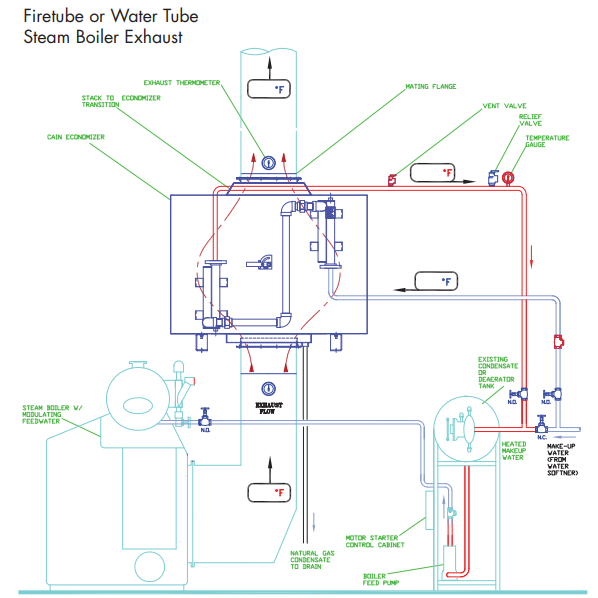
CXL single-stage installation schematic on a steam boiler: boiler exhaust through the condensing economizer, cold makeup or process water in, heated water out, bypass for low load
CXL installation: boiler exhaust through the condensing economizer, cold makeup or process water in, heated water out, bypass at low load.
  • One condensing stage: all recovered heat goes into one stream.
  • Heat sink: makeup water or process water.
  • Fewest connections, simplest piping, lowest installed cost.
  • Choose it when a steady flow of cold makeup or process water is available.

DXL — two stage

Cain DXL two-stage condensing economizer
DXL — two-stage condensing economizer, one casing with hinged access doors.
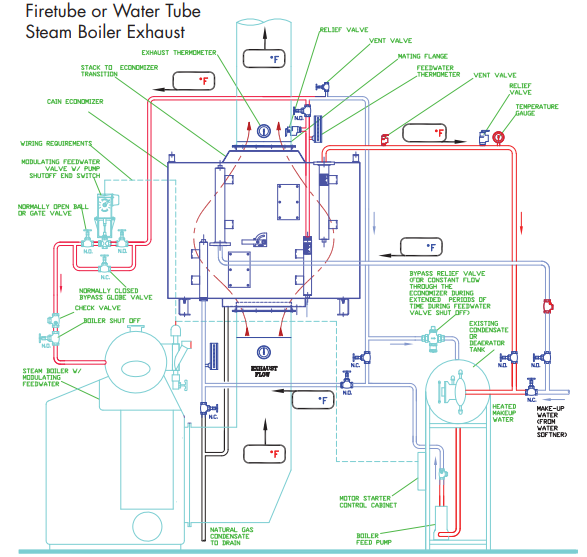
DXL two-stage installation schematic on a steam boiler: flue gas through both condensing stages, boiler feedwater heated in stage 1, makeup water in stage 2, condensate drained at the base, bypass for low load
DXL installation: boiler feedwater preheated in stage 1, makeup water in stage 2, condensate drained from the base, bypass at low load.
  • Two condensing stages in series: stage 1 preheats boiler feedwater, stage 2 preheats makeup water.
  • Heat sink: feedwater first, makeup water second.
  • Choose it when makeup water is limited or intermittent — feedwater flow keeps the unit condensing.
  • Highest total annual recovery of the two, because condensing hours do not depend on makeup demand.

Why both cool to the same temperature

Both are condensing exchangers built for the same physical job: taking the flue gas from 149–427 °C down to 77–49 °C, below the water dew point of the gas. That exit temperature is the target, not a coincidence. What differs is where the recovered heat is sent, and how many hours a year the exchanger stays in the condensing range.

How the saving is measured

CXL is measured once. The boundary is the boiler plus the economizer: flue-gas enthalpy in and out, and heat absorbed by the makeup or process water, corrected to steam output. One number comes out — 8.47 % of fuel on our demo plant (Avis Foods), IPMVP Option B. No split is reported for CXL.

DXL adds a second stage, so it carries an extra flue-gas temperature pair — gas in and gas out of the condensing stage — which measures the additional heat taken from the flue gas. That pair is what splits the same 8.47 % into 5.92 % recovered above the water dew point and 2.55 % from latent heat. Both numbers are measured on the same demo plant, not a catalogue figure.

See the full CHR specification →

How it works

Survey, install, verify. In that order.

No equipment is quoted before the baseline exists. The clocks below are the ones this page already runs on: a 12-month baseline, four metered streams at one-minute samples, a daily report.

STEP 01 · SURVEY

One business day to the questions

We send one page: fuel type, boiler size, flue temperature and the meter you already read. The survey is scheduled when the answers arrive, and the baseline is measured before any hardware is quoted.

12-month baseline · bills + steam output
STEP 02 · INSTALL

Tie-in on a planned shutdown

CHR sits on the flue gas and heats water before the deaerator; where the gas is cooled below the water dew point the vapour condenses, and the condensate is drained handling. A flue bypass and a safe-shutdown procedure are part of the installation requirements; the burner is not modified.

No burner change · no re-certification
STEP 03 · VERIFY

Four streams, one minute apart

Fuel, steam, flue gas and condensate are sampled every minute. You get a daily report and, on the Plant plan, a monthly PDF. If the feedwater leg and the flue-gas leg disagree, no saving is booked.

4 streams · 1-minute samples · daily report
The rest of the stack

Heattech Pulse measures it. Heattech CT stops the waste at the burner.

Heat recovery is the visible half. Before it comes metering, and beside it comes combustion — two modules that decide whether the saving on the dashboard is real and repeatable.

Estimate

What the recovered heat adds up to.

The demo plant recovers 771 kW right now. Move the hours and the same rate is applied across a year. This is arithmetic on a published figure, not a forecast for your boiler.

16 h/day · 365 days

Estimate only. Formula: recovered heat (kW, read from the demo plant's live figure) × hours per day × 365 ÷ 1,000 = MWh per year. It assumes the plant runs at that rate all year. It is thermal energy at the feedwater, not metered fuel, and it excludes standby, part-load and seasonal effects.

Recovered heat per year
4,503 MWh
771 kW × 16 h × 365 days, at the demo plant's current recovered heat.
Pulse subscription

Simple, transparent pricing

The subscription covers PULSE — meters, dashboards, reports, M&V evidence. Two months free on annual billing. Hardware and installation (MV, CT, CXL, DXL) are quoted per site, against the savings we measure there.

Single plant
Up to 3 boilers
By contract
Signed contract · VAT invoice
Trial arranged per site
  • Live dashboard + daily report
  • M&V evidence pack
  • Savings history, exportable
Request a quotation
Fleet
More than 6 boilers
By contract
Signed contract · VAT invoice
Trial arranged per site
  • Cross-site benchmarking
  • Priority support
  • Consolidated group reporting
Request a quotation

Priced per boiler actually running — an idle boiler is not billed. Equipment (MV, CT, CXL, DXL) and installation are quoted per site from the measured saving, so the payback is documented before you sign.

Documents

What engineers ask for first.

Open the documents our engineers hand over before a survey — the same numbers this page is built on.

What we do not claim

The limits, stated the same way as the numbers.

A measured saving is only useful if the boundary around it is explicit. These are the things this page does not promise.

We do not measure electrical powerHeattech Pulse covers fuel, steam, flue gas and condensate. Power metering was removed from the MV scope, so the saving here is thermal and nothing else.
We do not promise a fixed percentage8.47 % is what this demo plant measured over its window. Your flue temperature, fuel and load profile set your number, and it is published after the baseline, not before.
We do not sell carbon credits89.1 t CO₂ avoided is a conversion of measured fuel, priced at the reference in the data ($32.48/t, CARB #48 Aug 2026). It is an accounting figure, not a tradable certificate.
We do not claim a saving without a baselineNo 12 months of bills and steam output, no published number. The cost per tonne comparison starts from your own invoices, normalised per tonne of steam.
We do not guarantee paybackEquipment is quoted per site from the measured saving, so payback is documented before you sign. It still moves with your fuel price and your operating hours.
We do not publish customers we cannot nameEvery plant on this page is a labelled demo: signals are simulated from plant behaviour, nameplate data and the unit datasheet. No logo wall, no borrowed testimonial.
Questions engineers ask

Eight answers, no brochure language.

Each answer is tied to a number or a document already on this page.

What is the difference between CXL and DXL?

They are the same condensing line in two configurations. CXL recovers in a single stage: flue gas is cooled below the water dew point and the heat goes into makeup or process water. DXL splits recovery into two stages, stage 1 preheating boiler feedwater and stage 2 preheating makeup water. CHR is the name of the condensing technology both models use, not a model name, and neither model is a dry economizer. On the demo plant the measured result is 8.47 % of fuel, IPMVP Option B, boundary boiler plus economizer.

Why does the dew point decide the design?

For LPG flue gas the water dew point is about 54.6 °C. Below it the vapour condenses and the latent heat becomes recoverable, which is the whole point of CHR. The real constraint is the acid dew point, which sits higher for fuels carrying sulphur, so CHR uses corrosion-managed materials, a drain path and a bypass that takes the unit out of the gas path.

How is the saving actually measured?

Four streams are sampled every minute: fuel at the burner, steam, flue-gas temperature and condensate. Recovered heat is measured at the feedwater and flue-gas temperature is the cross-check, then cost per tonne of steam is compared with your own 12-month baseline. If the two legs disagree, we do not book the saving.

What is the uncertainty on the number?

The M&V protocol publishes the baseline, the boundary, the calculation and the dispute path before you sign. We do not print a tolerance we have not measured, and the two-leg rule turns a disagreement into no booked saving rather than a wider error bar.

Do we have to stop the boiler to install it?

The tie-in is planned around a shutdown, and a flue bypass plus a safe-shutdown procedure are part of the installation requirements. CHR does not touch the burner or its certification; CHR adds a condensing stage with its own drain handling.

What does it cost, and what is the payback?

PULSE is agreed in a signed contract per plant, invoiced with VAT, with a trial period arranged per site. Equipment and installation are quoted per site from the measured saving, so the payback is documented before signing.

Who operates it after commissioning?

Your operators keep running the boilers. PULSE samples, rolls up and reports: a live dashboard, a daily report, and a monthly PDF savings report on the Plant plan. The live demo is read-only, so you can watch the numbers move before any conversation.

Can I check the numbers before buying anything?

Yes. The live plant is public and read-only, the M&V protocol and the datasheet are open documents, and the sizing tool runs the gas-side and water-side balance yourself. None of it needs a call.

Ask for the survey, not the brochure.

The next step is one page of site questions: fuel, boiler size, flue temperature and the meter you already read. If the numbers do not support a saving, we say so before anyone quotes hardware.

Reply within one business day. No equipment is quoted before the baseline is measured.